


The New York Sari Exhibit Review
A review I wrote on the New York Sari exhibit at the New York Historical.
A review I wrote on the New York Sari exhibit at the New York Historical.
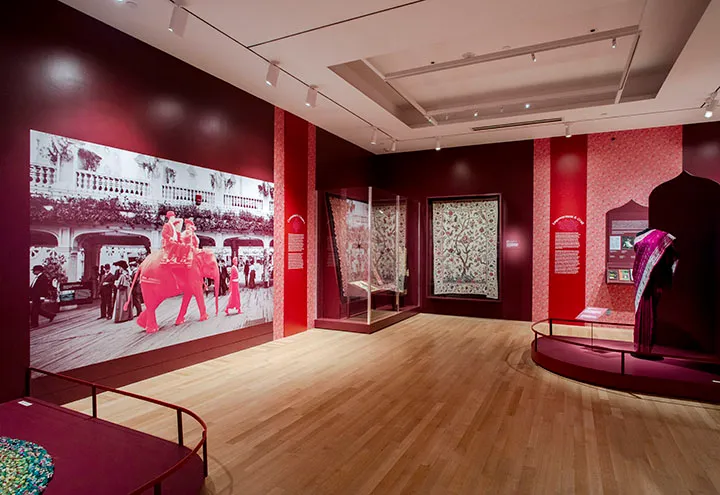
The New York Sari exhibit at the New York Historical Society, curated by Salonee Bhaman and Anna Danziger Halperin, seeks to offer a more conclusive exhibit that paints a more colorful picture of New York City’s sociocultural fabric. The exhibit is small, and houses a rapt selection of completed garments grounded through a compendium that “showcases the deep influence that South Asians have had on the culture of New York City from the Gilded Age to the present day” (“The New York Sari,” The New York Historical). The room itself is mostly open, notwithstanding a singular sari paired with its abstract interpretation made from indigenous and organic Indian cotton, and a vitrine discussing saris and sexuality. The other ephemera line the walls, physically surrounding the viewer as they move freely through the space. Without an otherwise clear track delineated, it invites its viewers to meander as they please, fragmenting the experience depending on who is walking and where.
This synthesized topos is still somewhat organized thematically: The exhibit begins with sari fibers and their construction before transitioning into their weaves and construction, tracking their influence as they existed within South Asia and spread to the diaspora, presenting punctiform examples of the garment in NYC and on specific persons on one side of the room, and finally considering their use within cultural practices like dance, politics, and LGBTQIA+ expressions on the other. Without clear direction, the exhibit simultaneously offers viewers agency in their interaction with its contents while risking disorientation, further amplified by a largely absent chronological anchor. Many of the garments are undated, absent of any temporal window, despite many objects donated and even being worn by people during specific eras of their lives, like the aforementioned sari as a centerpiece of the exhibit: Donated by Sudha Acharya, the Executive Director of South Asian Council for Social Services, the accompanying plaque explains that Acharya wore this Jamawar sari to her only daughter’s wedding in India—an event one might consider to be noteworthy, at least in regard to its date.
Beyond the critique of the unusual open floor plan and lack of dating, the exhibit perhaps bites off more than it can chew in such a small space: In pursuit of fusing the discussion of migration and diffusion in the exhibition’s garments while centering its raison d’être as its contribution to New Yorker culture, the entire intent of the exhibit—the New York sari in all of its transnational glory and effects—appears to be somewhat scant. The paucity of actual saris and an explicit connection to their broader impact on New York imperils the modifier of the New York sari, instead becoming more so an exhibit of the sari in New York. The thesis of the exhibit itself may be lost here: Instead of discussing the sari as it shaped and affected the South Asian diaspora and the broader multicultural qualities of New York, there was more emphasis on the dispersion of the sari in general, its coopting and colonization by imperialists and virtue-signaling consumers, and its meaning to/utilization by South Asian New Yorkers—all important and germane matters when considering how the sari made its way into New York’s sociocultural composition, but this largely misses what is assumed to be the intended point of the New York sari being a unique form; “a metaphor for the ways in which the individuals who wear and create saris have straddled tradition, culture, and modernity in their work, art, and lives” (“The New York Sari,” The New York Historical). It was, instead, an explicitly given explanation of the sari’s use in New York and how it gave identity as well as connection among others and to the homeland—not an allegorical stimulus meant to encapsulate the plight of resettling in a diaspora while maintaining cultural strongholds.
As reminded by Saloni Mathur, an art history professor at UCLA, postcolonial exhibitions often evoke asymmetries of colonial displays even as they attempt to critique them (Mathur 2). The New York Sari exhibit, in its effort to balance diaspora representation with curatorial legibility, dares slipping into this paradox, oscillating between anthropological framing and an almost aestheticization. Likewise, as noted by art historian and professor at the London College of Fashion Reina Lewis throughout her book Rethinking Orientalism: Women, Travel and the Ottoman Harem, diaspora dress operates in a tension between visibility and translation—a tension the exhibit touches on but never quite resolves, presenting the sari’s global diffusion without fully situating its localized identity within the city’s own semiotics.
That being said, had the title of the exhibit been even marginally adjusted to be titled, say, “The Sari in New York,” its contents would be precisely aligned. This would have given the multimedia included in the exhibit the space to be indeed a testament to belonging, tradition, culture, and modernity as claimed. Articles like the included cartoon strip would nod to modernity; discussion of the exploitation of South Asians in the early days of Coney Island would contribute to belonging; the sari worn by Shahana Hanif at her swearing-in, the first South Asian woman to be elected to the New York City Council, would fit underneath culture; and W.E.B. DuBois’s The Dark Princess would aptly connect “intellectual tradition[s]” of “freedom struggle[s].” Perhaps the title as is may be disjointed, but the contents as they are nonetheless become a very apt transdisciplinary representation of the sari in all its forms and extensions.
One could imagine an addition that would unify the exhibit, both as it is titled now and as reworked above, to anchor the sari’s diffusion in time and space, making its impact and offshoots legible in New York proper. In line with its approach geared toward modernity and multimedia, the exhibit could add an interactive digital map tracing the sari’s geographic, temporal, and cultural journey across New York City. The map would cover early South Asian immigrant enclaves to contemporary boroughs, diasporic communities, and fashion scenes, and visitors could explore anecdotes, images, or short videos connected to particular boroughs or neighborhoods (e.g., Queens, Jackson Heights, Richmond Hill)—showing how the sari adapted to and reflected different local contexts and historical moments (Asian American Federation). This addresses the exhibit’s lack of chronology and orientation, embracing the New York sari as a living and evolving entity, rooted in diaspora but continually redefined by the surrounding urban environment. It preserves the exhibit’s open, exploratory nature while redirecting the disorientation toward meditative meandering. Each click becomes an act of discovery, situating the sari within New York’s sociocultural tapestry.
This objective could be further expanded through a participatory installation that invites visitors to add to this map via digital “weaves” on a virtual sari, representing their own stories of migration, belonging, and cultural exchange. The resulting communal sari would grow over time, reflecting the dynamism and pluralism of the New York diaspora. Such interactive spatial mapping has been successfully employed in exhibitions such as The Fabric of India exhibit at the Victoria and Albert Museum in 2015, where curators combined materiality with digital ethnography to convey transnational textile production. While the New York Historical’s original exhibit could have done more to distinguish between the sari as a global and a New York form, this component literalizes the exhibition’s thesis: New York as a site of weaving together disparate traditions, cultures, and identities.
Ultimately, the New York Sari exhibit paints a deeply compelling thesis—but it may lack the connective tissue to fully realize it as is. By situating the sari as both an object of tradition and a vessel of transformation, the exhibit suggests how diasporic identity is not merely preserved but continuously rewoven through site-specific experience. The proposed additions, expanding its spatial and participatory reach, would anchor this idea with greater clarity, grounding the sari’s migratory story in New York’s geopolitics while inviting its viewers to inscribe their own. Such an approach would not only synthesize the exhibit’s scattered narratives but also fulfill its thesis of rendering the sari not just seen in New York, but of it.