Introduction: Ontological Fashion
The Museum at FIT’s recent exhibit Dreams, Dress, and Desire: Fashion and Psychoanalysis, curated by Valerie Steele, begins where most fashion exhibitions end: the psyche. Nearly a hundred garments and objects—ranging from Elsa Schiaparelli’s mirror jacket to Jennifer Lopez’s Versace “Jungle Dress,” or colloquially known in pop culture as “The Dress”—are reframed through the lens of the unconscious. Steele, fashion’s longtime Freud of the front row, stages psychoanalysis through a marriage of philosopher and designer, consummating the moment with a historical approach to both. Her accompanying publication and symposium make clear that this exhibit is not an accessorizing project but a manifesto: Fashion is not just reflective, but ontological.
Steele’s thesis that fashion is a “deep surface” where psychic life takes shape is not new, but it is newly institutionalized: Only within the last 30 years or so has fashion cemented its role in the broader field of theory, and Steele has hailed the exhibit as the first of its kind to join fashion and psychoanalysis through curation. The show joins a lineage of FIT exhibitions (e.g., Love and War: The Weaponized Woman; A Queer History of Fashion) that have demanded fashion be intellect; a spoke in the broader academic wheel that is mainstreaming fashion theory—an effort pioneered by scholars like Caroline Evans, who framed fashion as a psychological and sociopolitical site. Steele’s exhibition extends this endeavor into spatiotemporal form.
A Chronology of the Psyche
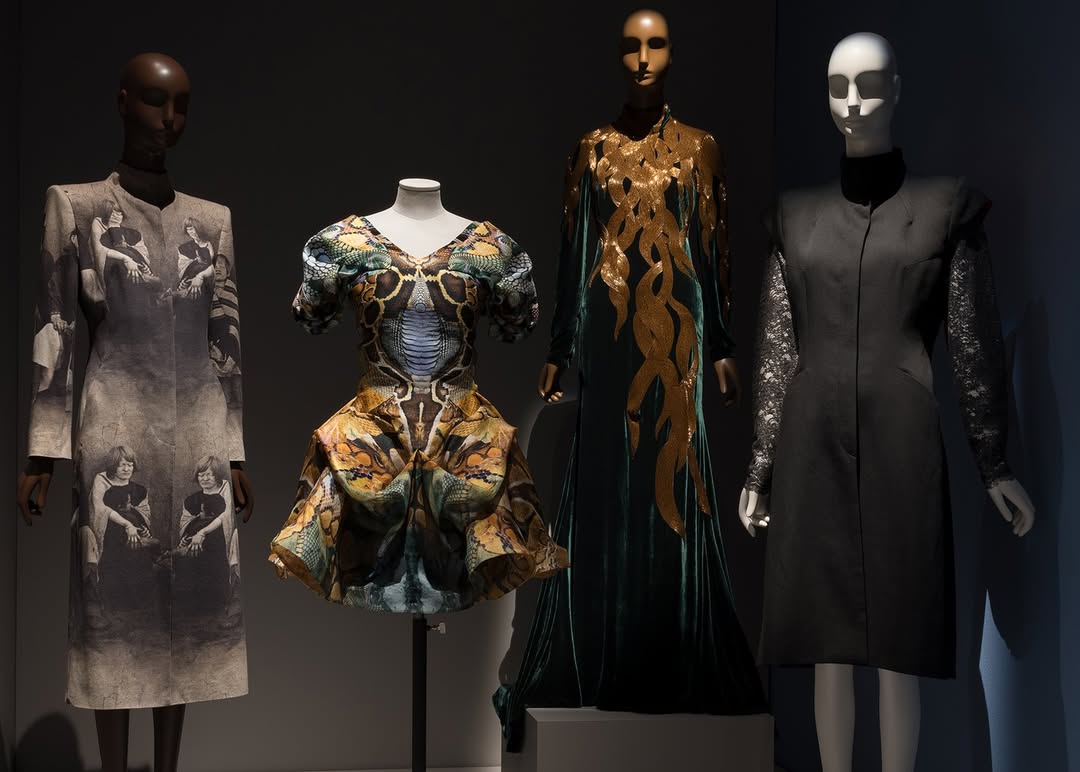
The show is organized both chronologically and thematically—a curatorial eight-fold path. The first gallery lays out Freud’s Vienna like a well-tailored case study: Vitrines pair Freud’s Interpretation of Dreams with garments that make fantasy, repression, and disguise material. In the first room, neatly laid out in an open-gallery form, early-twentieth-century silhouettes echo Victorian propriety, then slowly unravel into surrealism’s subconscious, suited in Dalí and other absurdist artists.
From here, we move into the concept of Lacan’s mirror stage, represented most directly by Schiaparelli’s 1938 mirrored evening jacket—its reflective embroidery inviting viewers to spot themselves, or the fragmented reality of the exhibit itself, in its glint. Nearby, Moschino’s “Fig Leaf” swim trunks harken back to French psychoanalyst Didier Anzieu’s skin-ego: a Freudian Garden of Eden for shame, modesty, and wit (and, one suspects, an intent of irony). Fetishism gets its own Freudian nod through knee-high leather boots that accentuate the foot, paired with a discussion of repressed desires. Nearby, Lopez’s famously barely-there, butterfly Versace green dress from 2000 flutters under the banner of the accompanying plaque dubbed “The Object of Desire.”
And yet, for all its theoretical foraying, the exhibition perhaps assumes too much: It seems to expect that everyone strolling down Seventh Avenue has read Freud and Anzieu, among others. The result is both thrilling and insular to its viewer, depending on their existing knowledge. Much like a dream that makes sense until one wakes up, it risks losing the listener halfway through the telling.
Moreover, the exhibit’s accompanying texts did not push its viewers; they were tailored tightly for an audience with preexisting knowledge of philosophy—specifically, Freud and his contemporaries. It was an exhibit of little words, anchoring its materiality in blurb-like plaques connecting each piece to a subfield of psychoanalysis, like one crowning Lopez’s dress. But few blurbs were neither dense nor synthesizing enough for a well-versed viewer, and simultaneously contained too many out-of-context references in such a brief space to truly explain the references to those not privy. The exhibition seemed to both demand and discourage pre-existing knowledge, providing little mediation between the theorist and the viewer and risking an air of psychoanalytic fashion as elite discourse—a paradox that undercuts both the exhibit’s free-of-charge accessibility as well as Steele's own "commune" past, her DIY path that brought her into fashion, and one of the main theses of fashion academia/theory altogether (decolonizing knowledge and transnational consideration).
One could imagine an internal remedy to this absence, perhaps in the form of a continuation of the already meandering second room of the exhibit (to be further touch on in the next section): Instead of solely the existing minimalist, planetary soundtrack, another passageway could be an added, set to fragmented sound bites of Freud and Lacan readings—a digestible format for those just discovering their works, and an aesthetic addendum to those already familiar. The current exhibition already gestures toward a labyrinthine, subconscious architecture with the dim and curving nature of the second room, and this corridor—conceivably embellished with, say, more mirror-like pieces—would heighten that disorientation. An evocation of dream logic through sensory bewilderment and reflection would further make visitors feel this dreamwork, condensation, and psychoanalytic displacement through space rather than text, deepening the exhibition’s phenomenological engagement as intended.
Silence as Method
And still—to play devil’s advocate within this review itself—perhaps the absence of longer-form, contextualizing texts like the several essays in the Superfine: Tailoring Black Style Exhibit at the Metropolitan Museum of Art was intentional. The restraint may be read as more than just provocation; a curatorial Freudian slip, per se, where what is unsaid speaks instead. An audacious gamble—pedagogy by projection—but one that pays off. The metaphors land so cleanly that there is little left to interpret, and the unconscious instead reveals itself. The tone is matter-of-fact, instead placing the responsibility of reflection on the viewer. Steele silently asks: How does this make you feel? Are you attracted? Repulsed? Do you see yourself in this? In the garment? The text? But that is exactly the point—the exhibition is not just analysis but dreamwork, inviting viewers to project, repress, and desire as they will.
The idea is seductive: Fashion does not just reflect the unconscious, it constructs it—exactly as Didier’s skin-ego predicted and precisely for the viewer to undergo as well. Steele’s curation advances the field’s ongoing turn from sociology to phenomenology, examining how clothes feel more so than what they do. Within the dark exhibit and the second room’s winding hallways, ocean imagery, and the susurrus ambient music, the space itself becomes holy and meditative, bringing its viewer to its level and headspace.
The construction itself enacts this psyche. Corridors wind, thresholds repress, and the mirrored surfaces offer recognition and estrangement from oneself all at once. By translating psychoanalytic motifs into displays of mirrors, veils, and disjointed mannequins, Steele makes theory tangible. The effect is liturgical and cinematic, and the result is a kind of visual psychoanalysis itself, in which the exhibition becomes a patient, anxious and desirous. The space demands a slower pace, as if one might trip on one’s own projection. This curatorial choreography—almost reminiscent of the ambiance in Steele’s 2008 FIT exhibit titled Gothic: Dark Glamour through its darkness, introspection, and labyrinth-like mise-en-scene—finds its purest form here. Theory becomes atmosphere. Steele’s curatorial intelligence shines. Object becomes a case study in material psychology: the self as surface, the garment as mirror, the body as text. Ultimately, Dreams, Dress, and Desire doesn’t just reframe fashion through Freud but reasserts the museum as the analyst, diagnosing the experience itself. Steele’s exhibition signals a curatorial practice coming into its own: fashion studies no longer framed by theory, but producing it.