

The Panopticon, Spectacle, Medieval Pillory, & Other Things That, Naturally, are Relevant to Valentino’s Couture Show
I posted a rambling take about this on my private story. Thought I should flesh it out.
I posted a rambling take about this on my private story. Thought I should flesh it out.
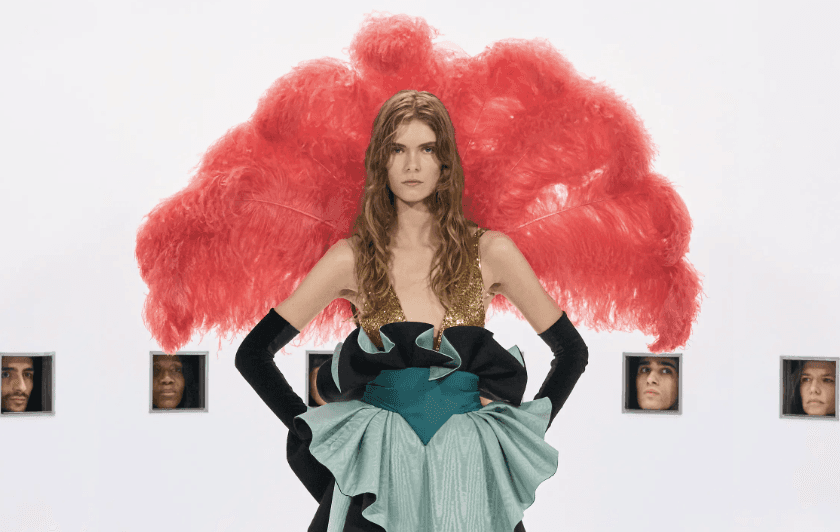
Designed by the king Alessandro Michele and displayed just a week and some after Valentino Garavani himself passed away, I found this show to be a truly apt memorium for him. I would say I think he would’ve loved it, but I know he would: The show began with clips from Matt Tyrnauer’s documentary Valentino: The Last Emperor, in which a clip from an interview with Garavani the day before his 2008 retirement frames what is about to come next. Garavani cites film as one of his life’s fillips, the “dream of [his young] life” to see “beautiful ladies” on the silver screen. Note: I am not an emotional person. In fact, the only things I cry over these days are PETA commercials, the Heated Rivalry finale (which, shoutout to my roommate who made me watch it—did not think I was going to like it. Was wrong), and now, apparently… this show’s opening. Something about aspirational Italian men just gets to me (seemingly a common theme in my life in a few ways, BTW). But that’s neither here nor there.
The set design nodded to Garavani’s love—wait, that’s reductive. The set entirely encapsulated this. The production echoed the Kaiserpanorama, a late-19th-century form of mass visual entertainment that let multiple people simultaneously look at stereoscopic photographs through individual windows, creating a shared illusion of three-dimensional scenes (a precursor to film and far ahead of 3D cinema). The show included thirteen Kaiserpanoramas, seating each attendee in a small window frame, looking into a circular room in which one model at a time entered, paraded, and moved on to the next group. Twenty-two viewers surrounded each circle for a total of ~286 attendees—a murderous slashing of the typical 500-1,000 attendees of big brand shows in the big four cities (New York, London, Paris, and Milan, although I likely needn’t remind you if you’re already reading this post). One (me) could imagine that this decrease in those invited to the show likely meant “smaller” guests—such as influencers, bloggers, and industry guests—did not make the cut. Not that these people are expendable; it is more so that this filtered the crowd into a conglomerate of those in the ingroup, or at least, crucial for the advancement of the brand’s image, prestige, and ambiance.
The set was not just an homage to Garavani’s younger inspirations, but intellectually and creatively genius. I’m almost shocked that such a setup hadn’t been used before… but then I remind myself that fashion shows have reached a point of no return in their spectacularization, untethered to anything but the spectacle itself. Yes, every now and then I am wowed by a current show’s balance of entertaining presentation and focus on the fashion itself—like, IMO, Maison Margiela Spring 2024 Couture Collection, or Gucci’s “Twinsburg” RTW Spring/Summer 2023—but I fear this equilibrium is a dwindling art. Just one day earlier, Matthieu Blazy debuted his first haute couture show for Chanel, known for his/their insaaaaaaaaane set designs. Don’t get me wrong—I love to look at it, as does seemingly most of the critics—but I find myself looking at the set perhaps… more than the clothes? There, I said it. Sue me.
Side note: I suppose I am more sympathetic to a more zhuzhy set design when it is done for prêt-à-porter shows, since those collections are meant to be fantastical translations of the real word, a semi-accesible iteration of clothing at the most pristine, covetable level (but, lol—let’s be real about accessibility here, both re: price and suitable body type). It is the acme of world-building, whereas couture collections are the apex of artisanship. They are meant to showcase the skill levels of the designer and the seamstress and the labor they provide, putting them in the catbird seat relative to the rest of the industry and smaller brands. Couture is about craftsmanship, how a garment hangs on the body, and the way the model brings an otherwise dormant object into activity. Of course, it would be wet behind the ears to pretend that beautification and ornamentation are not part of the fun of fashion, but it’s not all of it. We viewers tend to forget what the point of all this all is: that true artistry is stripping away the wow of the set, the beauty of the models, and still leaving the audience wooed by the quality alone. And, woo and wow was Valentino indeed.
Anyway. Back to the set design, which is what I want to talk about most here. Needless to say, I prefer a show that I can connect to theory, philosophy, politics, or something that makes the opulence seem worth it, not one that just gags me. Though a good gag is a good gag, art—and especially fashion, as an interface between the body and the regulated status quo, a hierarchical who-can-wear-what of social castes and regional norms, a way in which one presents themselves in their reality to help themselves and others make sense of them, a human practice that can be investigated as a means to explain a wide range of phenomena—is inherently political, philisophical, and theoretical.
One of my favorite theorists, who I think had the most moving read on this, is French Marxist theorist and philosopher Guy Debord, whose much-ahead-of-his-time book, Society of the Spectacle, was published in 1967. In it, he discusses a late-stage capitalist society so overrun with mediated images that these representations organize economic life, politics, culture, and interpersonal relations altogether. He considers modern life as an “immense accumulation of spectacles” through the “autonomous movement of the non-living” (quotes from the literal first page of his book, although I cannot recommend the full text enough). In fashion’s case, this could be: the rise and fall of microtrends; fashion show attendees live-streaming the event; culturally appropriated designs/silhouettes/textiles being blankly reproduced; resale markets spiking prices to the nth degree; and the like. Debord argues that, although there may in fact be an underlying reality detached from the spectacle rather than entirely removed, the spectacle increasingly replaces real labor and power with conspicuous and representative consumption. As these representations proliferate, they move on their own, circulating independently of the real, material, and lived conditions that bore them.
Yet, I would go as far as to argue that the very spectacle of this show was an anti-spectacle. It was a refusal of empty representations and self-circulating mediations in a closed orbit (mediation, if there is any confusion, is to refer to Spanish-Colombian semiologist, theorist, and anthropologist Jesús Martín-Barbero’s theory of mediation, i.e., how media is culturally received and re-signified—but don’t get too caught up in the weeds here). Although fashion, generally, is still indeed a reorganization of social life around appearance and passive contemplation, this show moved away from Debord’s spectacle in a few ways: Firstly, it reincorporated the audience as an active part of the process. By literally framing the audience through windows lining the panoramic arena, the show rendered spectatorship itself visible rather than passive, no longer outside the image economy but instead confrontational with its own role within it. Secondly, the looks were not collapsible into instant, consumable imagery, and no one attendee could see the whole show at once. Whereas the spectacle thrives on speed and circulation of images to remain valuable, the Kaiserpanorama structure capitalizes on duration and the lack thereof. Finally, and somewhat collectively, the show acknowledges the spatiotemporal limits of craft, exertion, and participant perceptibility. Where the spectacle replaces lived labor with its image, the Valentino show instead forces proximity to one’s own visibility, the garment’s construction, and the model/look as ephemera.
I think of the Panopticon as another fitting way to consider the audience’s key function. The Panopticon, an 18th-century institutional design by English philosopher and social theorist Jeremy Bentham, discusses the behavioral effects of a prison with a central observation tower surrounded by a circular, multi-story cell block. Few guards are able to monitor many inmates at once, who cannot see into the tower, forcing them to assume they are watched constantly. This omniscient mechanism induces self-regulation in the prisoners, who then behave better.
Consider this show its own panopticon, with the roles flipped: A normally situated fashion show has a well-lit catwalk, with the focus off and away from the audience. The flash of the press’s camera and stage lighting hides the perimeter of attendees from the model, yet, with the knowledge of their attendance and the internet, she performs, or “behaves better,” in Bentham’s terms. At Valentino, the press remained the guard, but the audience was the prisoner. Yes, perhaps the model indeed still knows herself to be watched—theoretically. But philosophically, the model's role in the metaphor is obsolete. Instead, the roles are now shifted: When read through a panopticon, the spotlight shifts to the audience. They are not just seen—they are spotlighted. With their faces physically framed by windows and lit by the central lighting, they are on blast, their facial expressions and phone usage alike. It’s as if to say: “Oh, so you want to snap a picture for your story? Do so freely, but do so knowing your face and hand movements are encased by a frame, restricted like a medieval pillory and imprisoned by the plight for social media clout.”
I (upsettingly; shockingly) was not invited to this show, so I did not see this philosophy play out in live time, but on Vogue Runway’s website of the show, not one image shows a member of the audience with their phone out. Surely, some did photograph, but the philosophy largely worked: attendees may not have totally behaved perfectly, but they behaved better. In the true Panopticon, the occupants are constantly aware of being watched—this is the whole point—but the same is true at this show: There may be no literal physical tower nor a looming guard, but the camera and the subsequent image published online are. The audience knows itself to be watched, incarcerated by their own social media use and the inevitable post-show imagery to be posted, and they fall in line.
Fashion has descended so deeply into Debord’s idea that Valentino’s show was able to loop back around through a horseshoe effect: The spectacle was grounded in Valentino’s real upbringing, the Kaiserpanorama’s real technology, Bentham’s philosophy, and even the social/fashion history of the notably 1920s motifs of the garments themselves (feathers, velvet capes, art-deco motifs, etc.)—recentering the representation around the design quality, labor, and power that is usually sanitized through the Disneyfication of fashion shows. To TL;DR the last five paragraphs: Reality was reattached through every component of this show. Spectacle was diluted. Mediation teetered closer to the edge of human control. Audience was confronted with their own role, readjusting it. Visible labor was appreciated anew rather than shrouded by extravaganza and personified by model. All in all, the Valentino show was far from another spoke on the spectacular wheel—it was an escape from the oversaturation of fashion, so much so that it almost escaped Debord’s take on late-stage capitalism altogether.