

Fascism is so Last Season! Sartorial Satire as an Agent of Italian Fashion & National Identity, from Mussolini to Today
My graduating honors thesis for the Culture and Politics major under the BSFS at Georgetown University.
My graduating honors thesis for the Culture and Politics major under the BSFS at Georgetown University.
This is my baby, my shayyyyyla, my undergraduate senior thesis from my time at the SFS. I'm sure the acknowledgements at the beginning of the paper show you how nostalgic and emosh I was upon completing this paper.
This is a loooooong read, so I am attaching it as a PDF here. PS: Check out the footnotes. Yes, some are citations, but some are jests, too.
Man, I wish I could rewrite this with just the one semester's worth of knowledge I have from Parsons. I feel like I have learned an insane amount about not just how academic papers in the field of fashion theory are written, but about the specific subject matters I discuss in this one. I plan to revise it and expand on it thoroughly—I want to get this published one day.
This is a short paper for a thesis—just under 40 pages. I was frustrated with these page limits (and don't even get me started on the time limit we had for our defense—would you believe me if I said it was only **6** minutes?) What a joke it was, after a full year of research, to expect us to reduce our findings to the length of a graduate school final and pitch it in the same time as the length of Bohemian Rhapsody by Queen. At the end of the day, I'm still very proud of this paper, but I still believe that it would have been a truly robust theoretical framework with more writing. Hence, the future publication goal—once I have the time to keep researching this alongside the 1,000,000 other things I'm writing for school right now.
Because of the short page limit, I do not include a formal literature review in the text—i.e., I do not explicitly go over the existing literature on this subject or the gaps I am trying to address (another thing I am itching to add). That said, I must attribute much of my success in my own research to the works of scholars Natasha Chang and Eugenia Paulicelli, and to the theorizing of fashion studies in general by philosopher Roland Barthes.
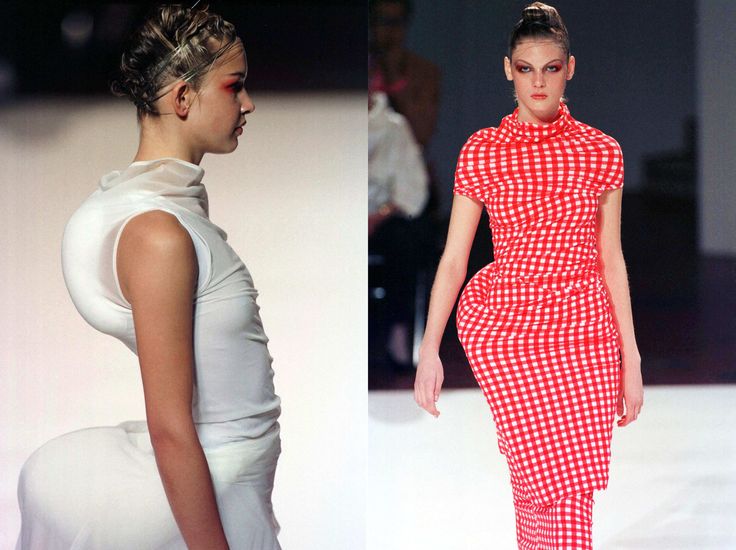
This thesis introduces the concept of “Sartorial Satire” as a critical framework for examining fashion’s role as a sociopolitical tool in shaping Italian national identity from the Fascist era to the present. Sartorial Satire, defined and premiered here as deliberate irony and parody woven directly into garments to critique societal norms, is explored across central moments in Italian fashion history. Beginning with Fascism, where fashion and satire were co-opted to bolster the nationalist identity, this thesis then traces how postwar designers like Elio Fiorucci, Franco Moschino, and Miuccia Prada harnessed satire to subvert established norms and present Italian equivalents, elevated through the satirization of others. Considering the Paninari subculture of the 1980s further demonstrates Sartorial Satire’s capacity as an entire social movement through localized cultural critique. By analyzing self-reflective Italian trends and redefinitions of aesthetic conventions, this research argues that Sartorial Satire has not only undermined traditional notions of taste but has also continuously redefined Italian identity, worthy of theoretical analysis that can be extended to both Italian and international stratifications. The study situates Sartorial Satire within a broader cultural and historical narrative, positioning it as both a critique of and a response to prevailing ideologies.
This study makes a few jokes here and there, too.
Keywords: Sartorial Satire, Fascist Fashion, Italian National Identity, italianità, sprezzatura, Camp, Kitsch, Satire, Comedic Fashion, Fiorucci, Pucci, Paninari, Moschino, Prada