


The Manhattan Vintage Show as an Ecosystem of Expertise
Getting your master's at Parsons is cool because they send you to one of the biggest vintage markets in NYC to interview the attendees—and also shop, obviously. Here's how that went:
Getting your master's at Parsons is cool because they send you to one of the biggest vintage markets in NYC to interview the attendees—and also shop, obviously. Here's how that went:

On a sub-20°, late January afternoon on West 18th street, shoppers shuffled through the Manhattan Vintage Show between racks and racks of fur-trimmed coats, many sequined coinbags (and I mean many—I lost count of how many at the seventh stall that had them), and sweatshirts that cost more than a MetroCard monthly. If shopping second-hand once conjured the image of rummaging through bins in the name of sustainability, this was something else entirely: vintage as industry, vintage as prestige, vintage as an economy of knowledge.
The market, held thrice annually in Manhattan, is less a thrift store than a curated arena—one where the value of a garment is determined not just by its fabric but by belonging to the in-group. Even vendors have to apply to sell here, with enough social media presence to get the gig. But who recognizes the tag? Who understands the decade? Who can afford the price? Who can fit into what is being sold?
Second-hand shopping, it seems, has split into two linguistic worlds: thrifting and vintage. Subtly different, but very dissimilarly charged.
“Thrifting—and make sure that you define thrifting for what it is: going to thrift stores—still has maintained its thesis of sustainability,” vendor Sofia Wallis explained. Wallis, in her mid-20s and from the Hudson Valley, has a whopping 62,800 followers on her own NYC luxury consignment showroom, @shop.farmersdaughter. “But… curated luxury vintage shopping [like the market] was never really about that. It’s kind of providing a service for people who prefer not to dig through and rummage through.” In other words: the romance of the hunt has been replaced by the luxury of the find.
That shift comes with plausible deniability. Shoppers still invoke sustainability, even as scarcity—and status—creep in. “I think people are still into it for those original reasons,” shopper Wren Britton surmised. Britton, 53, a freelancer, merchandiser, jewelry maker, and clothing designer from New York City, does “a lot,” in his own words—evident on his equally eclectic Instagram @purevile. But, in his movements throughout the fields, he has come to know that there is indeed “a lot of status, and some things are harder to get now because they become popular.”
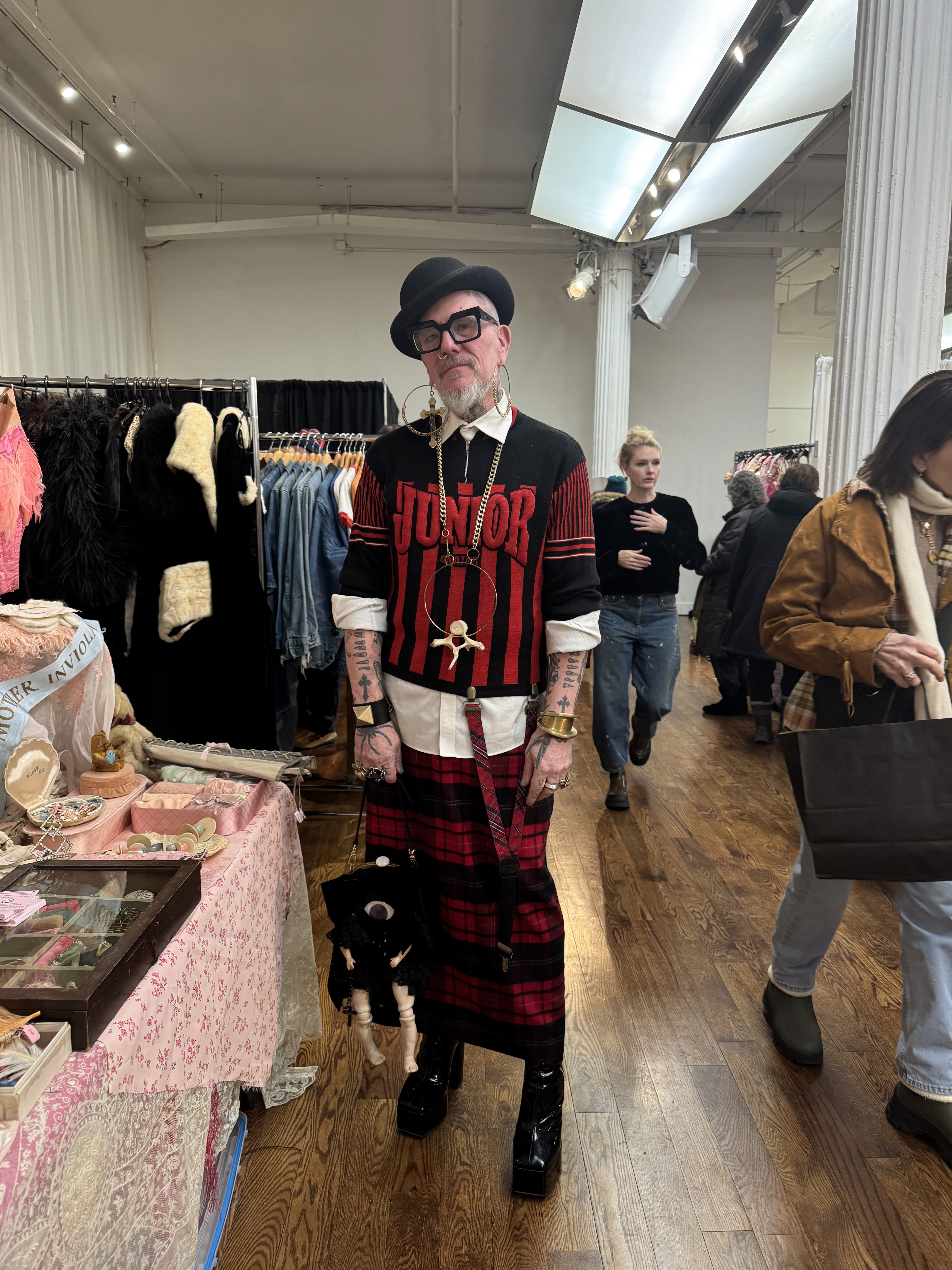
Wren Britton at the Vintage Market. Photo by author.
Adrienne Reau, 29, self-described “that bitch” (I would agree) and an influencer, was attending the market for her fifth or sixth time (side note: she is a fave influencer of mine, and with 203,000 people following her @ageorama, I’d imagine there are several people who would agree with me). Reau, from Ohio but now living in NYC, has seen the flora and fauna of both thrifting and secondhand across state borders, making her somewhat of a pro on the craft. With her expertise, Reau wanted to believe sustainability remained central, insisting it was “still very much at the forefront,” before backpedaling and asking: “Sometimes… I mean, I guess… I guess it depends on who you're talking to, right?” Right, Ms. Reau.
And then, of course, there is the question of who this world is actually for. Reau noted “a lack of plus-sized styles,” and emphasized that “this is not your Goodwill,” a distinction Wallis also made. Reau and Wallis aligned on a lot—both noted that people come ready to spend a lot of money.
Even within intentional curation and price points that imply authenticity, there is tension over what counts as “real” vintage. Married seller-duo Valerie Ferus and Nicky Santore of @thelastdaysofvintage, who are in their early 40s, spoke with bafflement about the obsession with Y2K. “All those t-shirts… were just nothing,” Ferus said, referring to graphic tees of the aughts that gestured to little but aesthetic, but chalked up to high prices. “We still see [the shirts being sold] as older sellers, and we’re like, we don’t get it.”
Wren, meanwhile, who has been coming to the market year after year as a buyer, watched the decades creep forward in real time: “There’s a lot more stuff from, like, the 90s… that wasn’t here when I was originally coming.” Vintage seems to be a spatiotemporal moving target.
Pricing at the market is high—but if money seems like the key to unlocking this world, it turns out even money is not enough without knowledge. A successful meander through the stalls and the subsequent haul is about knowing the rarity, labor, and insider recognition that goes into their curation. Reau argued that the price reflects “hours and hours of work… sourcing, cleaning, storing, hauling… the best of the best.” Wallis went further, claiming that with antique textiles, “there’s no such thing as too expensive,” because once it’s gone, “you’re never finding it again.” Ferus described a woman walking into the market, shocked by the cost of a sweatshirt—until it was explained to her that vintage has “a collector base,” dependent on “the label… the year… the tag.” Ferus called it “an education.”
That may be the clearest takeaway from the Manhattan Vintage Market: this is not just a place to buy clothes. It is a place to buy entry. Because in 2026—if not before—vintage shopping and thrifting have schism-ed: Simply second-hand is no longer a catchall term. Consider vintage as second-hand, first-class.